How to get better at sudoku, one quiet day at a time
Nobody gets better at sudoku by grinding harder puzzles in frustration. You get better by making the fundamental moves automatic, and that takes deliberate, daily reps.
To get better at sudoku: solve daily rather than in binges, master scanning before advanced techniques, use pencil marks honestly, learn one new technique at a time, and review where you got stuck. Small daily boards like Hueline's 4x4 and 6x6 color rounds make the reps short enough to actually keep.
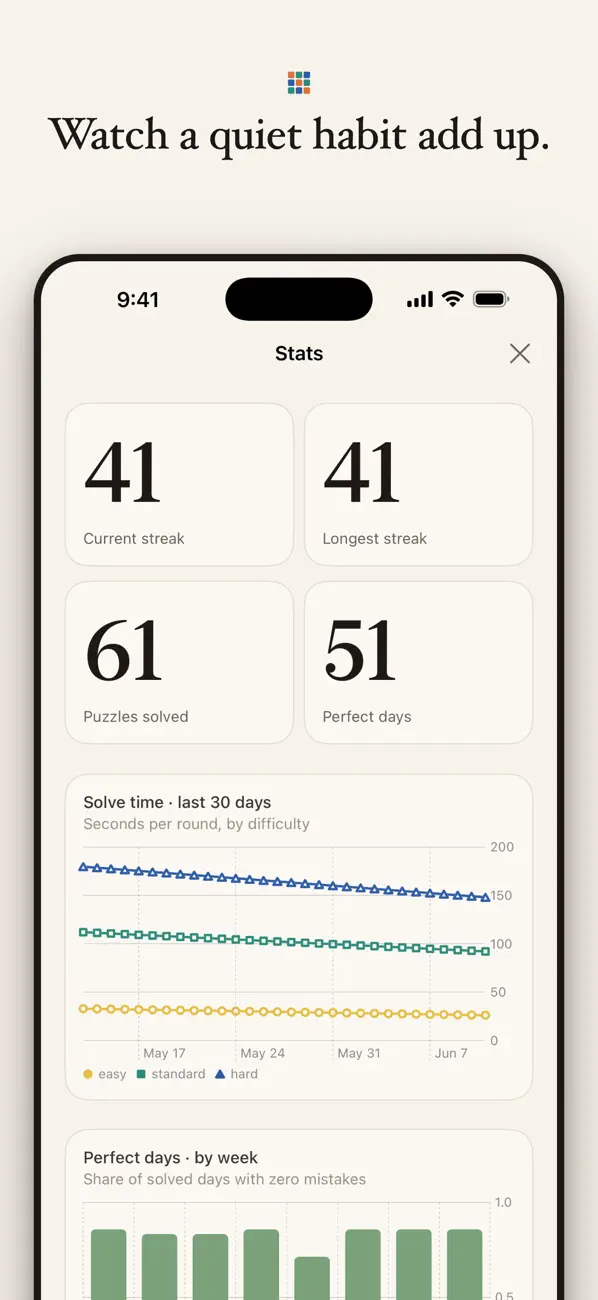
1. Trade binges for a daily rep
Skill consolidates between sessions. Fifteen puzzles on Sunday teaches you less than one thoughtful puzzle a day for a week, because each night your brain files away the patterns you noticed. This is the single highest-leverage change, and it is why daily-format puzzle apps work so well as training: the format enforces the schedule.
2. Master scanning first
Before any named technique, there is scanning: for each region, which symbols are missing, and which cell is most constrained? Sweep rows, then columns, then boxes, in order, every time. Color boards are a genuinely good place to drill this, because a missing color pops out faster than a missing digit and the feedback loop tightens.
3. Use pencil marks like a scientist
Pencil marks are not cheating; they are the difference between deduction and guessing. Mark candidates only when a cell drops to two or three possibilities, and update them the moment you place anything. In Hueline, tap and hold pencils in candidates.
4. Learn one technique at a time
The ladder is: naked singles, hidden singles, naked pairs, box-line reduction, then the exotic stuff. Spend a week where you deliberately hunt for the one technique you are learning. Stacking them all at once teaches none of them.
5. When stuck, re-scan instead of guessing
Almost every "impossible" state hides one overlooked single. Guessing corrupts the board and teaches nothing. Re-scan methodically; if truly stuck, a single gentle hint that points at the next logical cell (rather than filling it) preserves the learning.
6. Play sizes that match your level
Struggling on 9x9 expert grids builds frustration, not skill. A hard 6x6 forces the same eliminations with less bookkeeping, so you get more deductions per minute of play. Climb sizes as the small boards get easy.
7. Notice where the puzzle stopped you
The moment a solve stalls is data. Was it a hidden pair you missed? A box you never re-scanned? Thirty seconds of honest review after a hard round converts a stumble into a pattern you will catch next time.
- Play the three daily rounds each morning: warmup, standard, hard.
- On the hard 6x6, hunt this week's technique before anything else.
- Use pencil marks on every cell that drops to two candidates.
- Watch the Mosaic fill in: seven tiles is a week of real practice.
Frequently asked questions
How long does it take to get better at sudoku?
Are color boards good practice for regular sudoku?
Play today's color sudoku.
Hueline is free: three quiet rounds a day, no timer, accessible by default.